

New ABA Data Shows Rising Law School Diversity and a Widening Gender Gap
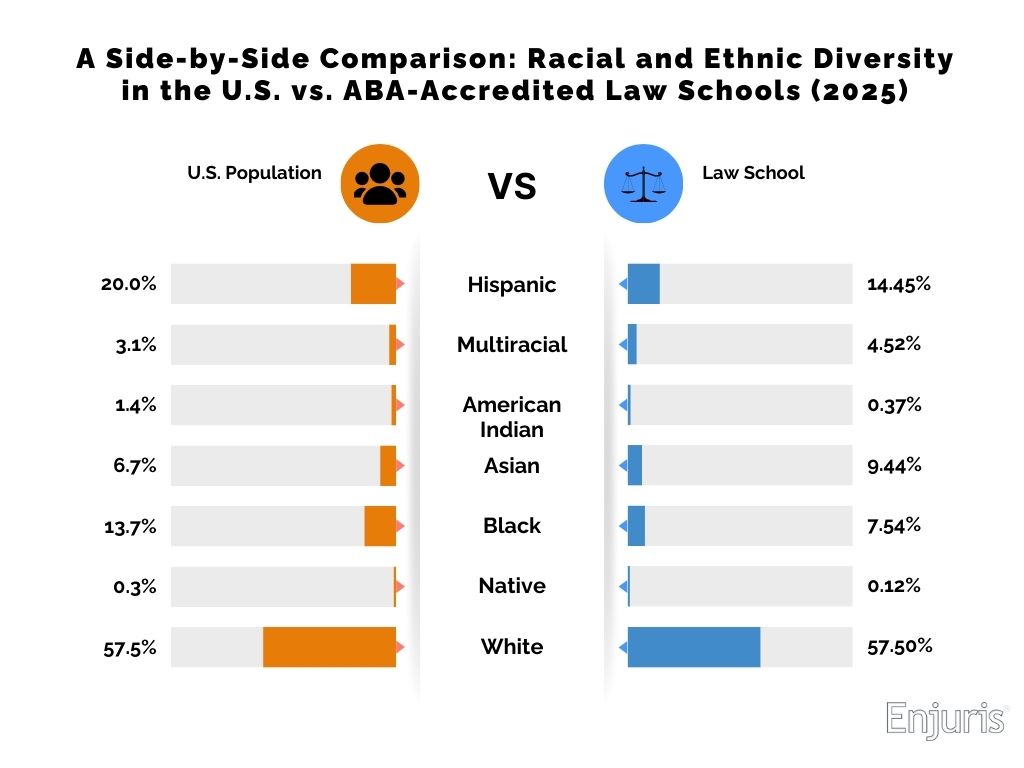
2025 Racial and Ethnic Diversity in the U.S. versus ABA-Accredited Law Schools
Eighth year of minority enrollment growth coincides with a widening gender gap in U.S. law schools, according to new ABA data
TAMPA, FL, UNITED STATES, December 19, 2025 /EINPresswire.com/ -- Enjuris has released two annual reports analyzing the latest demographic trends in U.S. law schools, based on data published December 16 by the American Bar Association (ABA). The reports—Law School Enrollment by Race & Ethnicity (2025) and Law School Rankings by Female Enrollment (2025)—offer a detailed look at how law school classrooms are changing amid shifting admissions policies and long-term educational trends.
Together, the findings show continued progress in overall diversity, alongside persistent disparities that remain largely unchanged.
Minority enrollment rises for the eighth consecutive year
According to Enjuris’ Law School Enrollment by Race & Ethnicity (2025) report, minority enrollment in ABA-accredited law schools increased for the eighth year in a row. In 2025, the total number of minority law students rose by 1,852 students, bringing minority enrollment to 43,744 students nationwide.
Minority students now account for 36.43 percent of all law students, up from 36.30 percent in 2024 and 31.28 percent in 2018. Hispanic and Asian enrollment continued to drive much of this growth, both reaching new highs in 2025. Enrollment among students identifying as multiracial also increased.
By contrast, Black enrollment remained largely flat. Black students made up approximately 7.5 percent of law students in 2025—more than six percentage points below their share of the U.S. population. American Indian and Alaska Native students remained severely underrepresented, with enrollment continuing a multiyear decline.
Diversity trends unfold amid post–affirmative action landscape
The 2025 data marks the second full admissions cycle since the U.S. Supreme Court’s June 2023 decision barring colleges and universities from considering race in admissions.
While early national data does not yet show dramatic reversals, Enjuris’ analysis suggests that the impact of race-neutral admissions policies may differ significantly across racial and ethnic groups over time. Hispanic enrollment has continued to rise, while Black enrollment has remained stagnant—a divergence that raises questions about long-term access and equity in legal education.
Women dominate law school classrooms for the tenth straight year
Enjuris’ Law School Rankings by Female Enrollment (2025) report finds that women once again outnumbered men in U.S. law schools—marking the tenth consecutive year women have held a majority.
In 2025, women accounted for 56.12 percent of all law students, up slightly from 56.10 percent in 2024. Men’s share of enrollment declined again, despite a small increase in the raw number of male students driven by overall enrollment growth.
The gender gap is especially pronounced at elite institutions. Fifteen of the top 20 law schools ranked by U.S. News & World Report enrolled more women than men in 2025. By comparison, only four of the top 20 law schools had female majorities in 2016—the first year women surpassed men nationally.
Male enrollment has declined steadily for 15 years, falling from 78,516 students in 2010 to 49,028 in 2024. Although male enrollment ticked up slightly in 2025, men made up a smaller percentage of the overall law school population than the year before.
“Men accounted for 57 percent of college and university students in 1970—shortly before Congress passed Title IX to prohibit sex-based discrimination in federally funded education,” the report notes. “Today’s gender gap is much larger in the other direction, begging the question: What, if anything, should be done about it?”
More law students decline to identify their gender
The reports also document a growing number of students who identify as another gender identity or choose not to report gender, a category that now accounts for 1.46 percent of all law students—up from less than 0.1 percent a decade ago.
While women’s gains in law schools are increasingly reflected in the legal workforce, Enjuris notes that women—particularly women of color—remain underrepresented in senior leadership roles, including law firm partnerships and judicial appointments.
About Enjuris
Enjuris is a platform dedicated to helping those affected by accidents and injuries. It supports families, caregivers, law students, and lawyers with comprehensive resources, including e-books, forms and worksheets, educational videos, and personal stories.
Ian Pisarcik
Enjuris
+1 800-366-1639
email us here
Visit us on social media:
LinkedIn
Instagram
Facebook
YouTube
TikTok
X
Legal Disclaimer:
EIN Presswire provides this news content "as is" without warranty of any kind. We do not accept any responsibility or liability for the accuracy, content, images, videos, licenses, completeness, legality, or reliability of the information contained in this article. If you have any complaints or copyright issues related to this article, kindly contact the author above.
