

Global Herbal Tea Market Led by Asia Pacific with Unilever and Tata Consumer Products Driving Growth
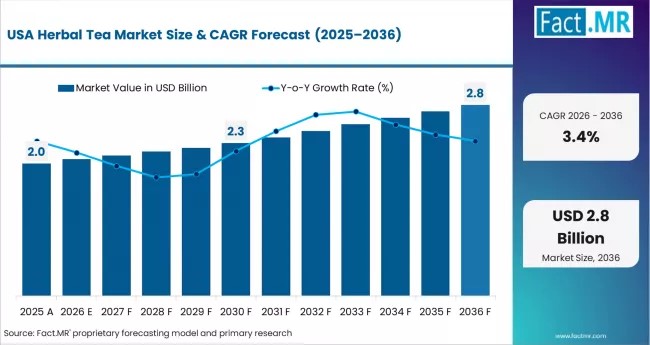
Herbal Tea Market grows steadily as consumers shift to natural, caffeine-free beverages for wellness, immunity support, and holistic health.
ROCKVILLE, MD, UNITED STATES, April 7, 2026 /EINPresswire.com/ -- The global Herbal Tea Market is undergoing a structural shift from a niche health category to a mainstream functional beverage powerhouse. According to a comprehensive market analysis by Fact.MR, the industry is projected to grow from a valuation of USD 4.6 billion in 2026 to USD 6.4 billion by 2036, expanding at a steady CAGR of 3.3%.As consumers increasingly pivot away from caffeinated and sugary beverages, herbal tea has emerged as the primary vehicle for "holistic hydration." The market is now being driven by the "premiumization of efficacy," where value is generated through verifiable health claims such as sleep support, digestive health, and cognitive clarity.
For Details Deep insights, Please Request A sample report for Free: https://www.factmr.com/connectus/sample?flag=S&rep_id=14658
Market Dynamics: A New Era of Functional Sipping
Consumer Migration: Over 32% of regular tea drinkers globally have shifted toward botanical infusions in the last 24 months, citing a desire for natural relaxation and immunity-boosting benefits.
Innovation Velocity: In 2024 alone, more than 480 new herbal tea SKUs were introduced globally, with functional blends—designed for specific clinical outcomes—now accounting for 25% of the total wellness beverage segment.
Segment Dominance: * Chamomile and Peppermint remain the volume leaders, holding a combined 42% market share.
Turmeric and Ginger blends are the fastest-growing sub-segments, expanding at 19% annually due to their strong association with anti-inflammatory benefits.
Supply Chain & Pricing: From Rare Botanicals to Premium Shelves
The herbal tea supply chain is currently navigating a transition from commodity aggregation to high-traceability sourcing:
Upstream (The Growers): China and India remain the dominant exporters, contributing over 25% and 15% of global biomass, respectively. However, the rise of "Rare Botanicals" like Moringa and Ashwagandha is diversifying the supply base toward Africa and Southeast Asia.
Midstream (Processors): Global ingredient giants such as Martin Bauer Group and Synthite Industries are deploying Ultrasound-Assisted Extraction (UAE) to preserve heat-sensitive bioactives.
Downstream (The Brands): Associated British Foods (Twinings) and Unilever (Pukka/Lipton) maintain market leadership, holding a combined 24% of the global category share.
Pricing Trend: Average selling prices (ASPs) have increased by 18.6% in real terms since 2020. This is driven by the rise of Ready-to-Drink (RTD) formats and "biodegradable pyramid bags," which command a 30-40% price premium over traditional paper tea bags.
Regional Insights: North America and Asia-Pacific Lead Growth
North America: The largest regional consumer, accounting for 40% of global volume. The U.S. market is fueled by a massive surge in organic-certified demand, which now exceeds 54% of all local herbal tea sales.
Asia-Pacific: Projected to witness the highest CAGR (7.8%) through 2036. Traditional tea-drinking cultures in China, Japan, and India are "up-cycling" their habits into premium, western-style functional herbal blends.
Europe: A hub for innovation in adaptogenic teas, with Germany and the UK driving a 24% rise in blends featuring Tulsi and Ginseng.
Competitive Landscape: Key Strategic Players
Associated British Foods PLC (Twinings)
Unilever PLC (Pukka Herbs, Lipton)
Nestlé S.A.
Tata Consumer Products
Yogi Tea
Numi Organic Tea
Risk Assessment & Future Outlook
While the growth trajectory is strong, the industry faces significant Supply Chain Volatility. Climate-induced disruptions impact nearly 18% of global production capacity annually, particularly for weather-sensitive flowers like Chamomile and Rose.
Investment Opportunity: The most lucrative "blue ocean" opportunity lies in Personalized Herbalism. Startups integrating AI-driven wellness apps with subscription-based herbal kits are seeing 22% higher customer retention rates than traditional retail brands. For decision-makers, the future of the market is not in flavor variety, but in traceable, clinically-backed potency.
For instant access to this report, click “Buy Now” or connect with our analyst for customization: https://www.factmr.com/checkout/14658
To View Related Report:
Industrial Chocolate Market https://www.factmr.com/report/industrial-chocolate-market
Instant Coffee Market https://www.factmr.com/report/instant-coffee-market
Limited-Service Restaurants Market https://www.factmr.com/report/limited-service-restaurants-market
Jerky Snacks Market https://www.factmr.com/report/jerky-snacks-market
About Fact.MR
Fact.MR is a global market research and consulting firm, trusted by Fortune 500 companies and emerging businesses for reliable insights and strategic intelligence. With a presence across the U.S., UK, India, and Dubai, we deliver data-driven research and tailored consulting solutions across 30+ industries and 1,000+ markets. Backed by deep expertise and advanced analytics, Fact.MR helps organizations uncover opportunities, reduce risks, and make informed decisions for sustainable growth.
S. N. Jha
Fact.MR
+ +1 628-251-1583
sales@factmr.com
Legal Disclaimer:
EIN Presswire provides this news content "as is" without warranty of any kind. We do not accept any responsibility or liability for the accuracy, content, images, videos, licenses, completeness, legality, or reliability of the information contained in this article. If you have any complaints or copyright issues related to this article, kindly contact the author above.
